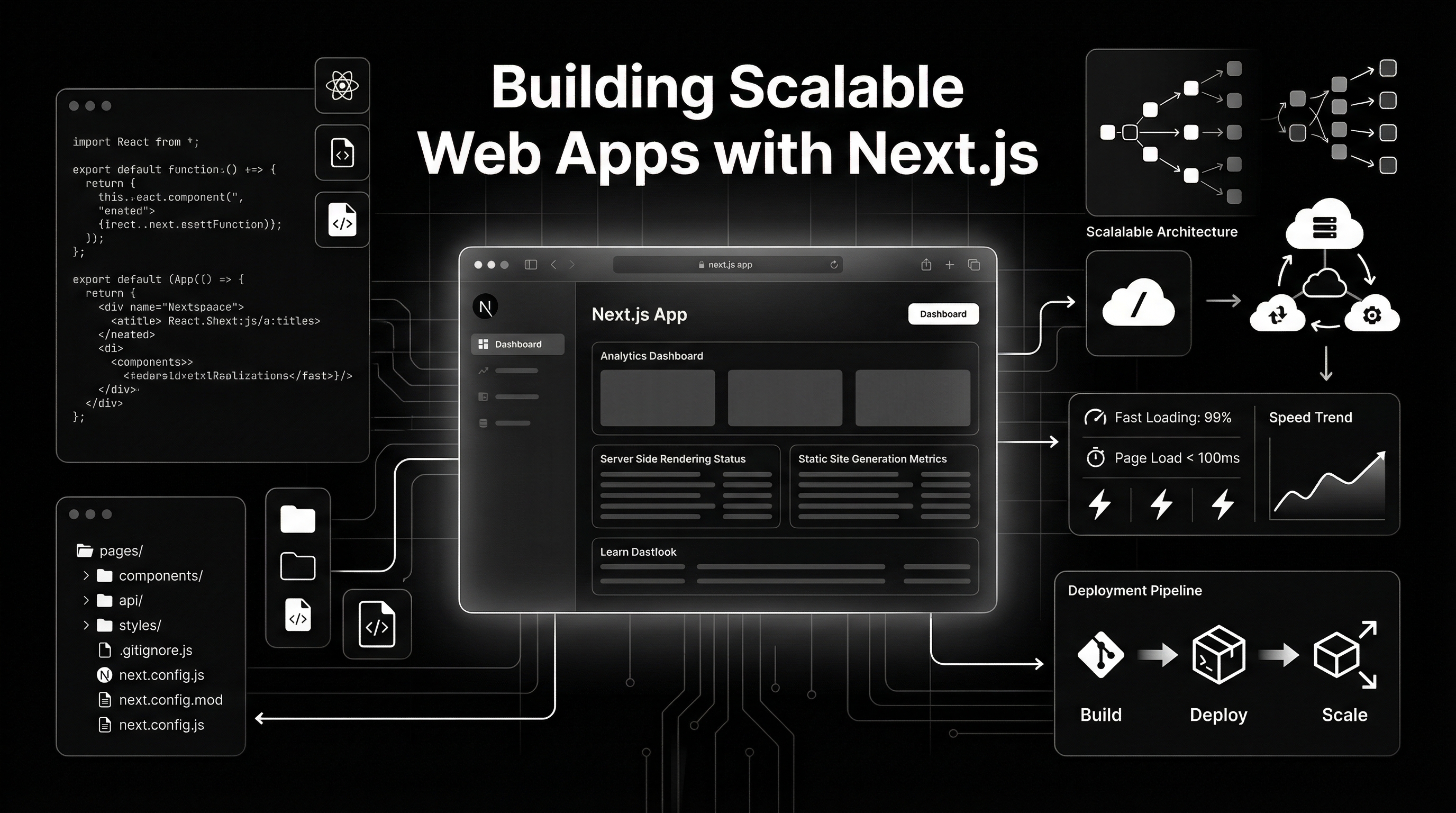
A deep dive into architecting performant and maintainable applications with modern frameworks.
Why Scalability Matters
In today's digital landscape, web applications need to handle everything from a handful of users to millions of concurrent requests. Scalability isn't just about handling growth—it's about maintaining performance, reliability, and user experience as your application expands.
Next.js has emerged as one of the most powerful frameworks for building scalable web applications. Built on React, it provides a comprehensive solution that handles routing, rendering, optimization, and deployment out of the box. Let's explore how to leverage Next.js for building applications that scale.
Understanding Next.js Rendering Strategies
One of Next.js's greatest strengths is its flexible rendering options. Choosing the right strategy for each page is crucial for scalability:
Static Site Generation (SSG)
SSG generates HTML at build time, creating ultra-fast pages that can be served from a CDN. This is ideal for content that doesn't change frequently:
- Marketing pages and landing pages
- Blog posts and documentation
- Product catalogs with infrequent updates
- Public-facing content with high traffic
// pages/products/index.tsx
export async function getStaticProps() {
  const products = await fetchProducts();

  return {
    props: { products },
    revalidate: 3600, // Revalidate every hour
  };
}
Server-Side Rendering (SSR)
SSR generates HTML on each request, perfect for dynamic, personalized content:
- User dashboards and account pages
- Real-time data displays
- Personalized recommendations
- Admin panels and internal tools
// pages/dashboard.tsx
export async function getServerSideProps(context) {
  const user = await getUser(context.req.headers.cookie);

  if (!user) {
    return { redirect: { destination: '/login' } };
  }

  return { props: { user } };
}
Incremental Static Regeneration (ISR)
ISR combines the best of SSG and SSR, allowing you to update static pages after deployment without rebuilding the entire site:
Optimizing Performance at Scale
Performance optimization is critical for scalable applications. Next.js provides several built-in features to help:
Image Optimization
The built-in Image component automatically optimizes images:
import Image from 'next/image';

<Image
  src="/hero.jpg"
  alt="Hero"
  width={1200}
  height={630}
  priority
  sizes="(max-width: 768px) 100vw, 1200px"
/>
Benefits include automatic format selection (WebP, AVIF), responsive image generation, and lazy loading out of the box.
Code Splitting
Next.js automatically splits code by route, ensuring users only download what they need:
- Each route is bundled separately
- Dynamic imports for component-level splitting
- Automatic tree-shaking of unused code
- Prefetching for faster navigation
API Routes and Edge Functions
Next.js API routes let you build backend functionality within the same project:
// pages/api/products/[id].ts
import type { NextApiRequest, NextApiResponse } from 'next';

export default async function handler(
  req: NextApiRequest,
  res: NextApiResponse
) {
  const { id } = req.query;
  const product = await getProductById(id);

  if (!product) {
    return res.status(404).json({ error: 'Not found' });
  }

  res.setHeader('Cache-Control', 's-maxage=300');
  res.status(200).json(product);
}
Database and Caching Strategies
Scalable applications need robust data management:
Connection Pooling
Use connection pooling to manage database connections efficiently:
// lib/db.ts
import { Pool } from 'pg';

const pool = new Pool({
  max: 20,
  idleTimeoutMillis: 30000,
  connectionTimeoutMillis: 2000,
});

export async function query(text: string, params?: any[]) {
  const client = await pool.connect();
  try {
    return await client.query(text, params);
  } finally {
    client.release();
  }
}
Redis Caching
Implement Redis caching for frequently accessed data:
- Cache API responses for anonymous users
- Store session data for faster retrieval
- Implement rate limiting
- Cache database query results
Deployment and Infrastructure
How you deploy your Next.js application impacts scalability:
Vercel Deployment
Vercel, created by the Next.js team, offers seamless deployment with automatic scaling:
- Global edge network for low latency
- Automatic HTTPS and CDN
- Preview deployments for every git push
- Serverless functions with auto-scaling
Docker and Kubernetes
For more control, containerize your Next.js app:
# Dockerfile
FROM node:18-alpine AS base
FROM base AS deps
WORKDIR /app
COPY package.json package-lock.json ./
RUN npm ci

FROM base AS builder
WORKDIR /app
COPY --from=deps /app/node_modules ./node_modules
COPY . .
RUN npm run build

FROM base AS runner
WORKDIR /app
COPY --from=builder /app/public ./public
COPY --from=builder /app/.next/standalone ./
COPY --from=builder /app/.next/static ./.next/static

EXPOSE 3000
CMD ["node", "server.js"]
Monitoring and Observability
You can't improve what you don't measure. Implement comprehensive monitoring:
- Performance metrics: Page load times, Time to First Byte (TTFB), Core Web Vitals
- Error tracking: Real-time error monitoring with tools like Sentry
- User analytics: Track user behavior and conversion funnels
- Infrastructure monitoring: Server health, database performance, API latency
Best Practices Summary
Keep these principles in mind when building scalable Next.js applications:
- Choose the right rendering strategy for each page
- Optimize assets using built-in Next.js components
- Implement caching at multiple levels
- Design for failure with error boundaries and fallbacks
- Monitor everything and set up alerts
- Test under load before going to production
- Plan for growth from the beginning